Hemma · Driveway · MMXXVI
Hand-poured terrazzo · Pittsburgh and Western Pennsylvania
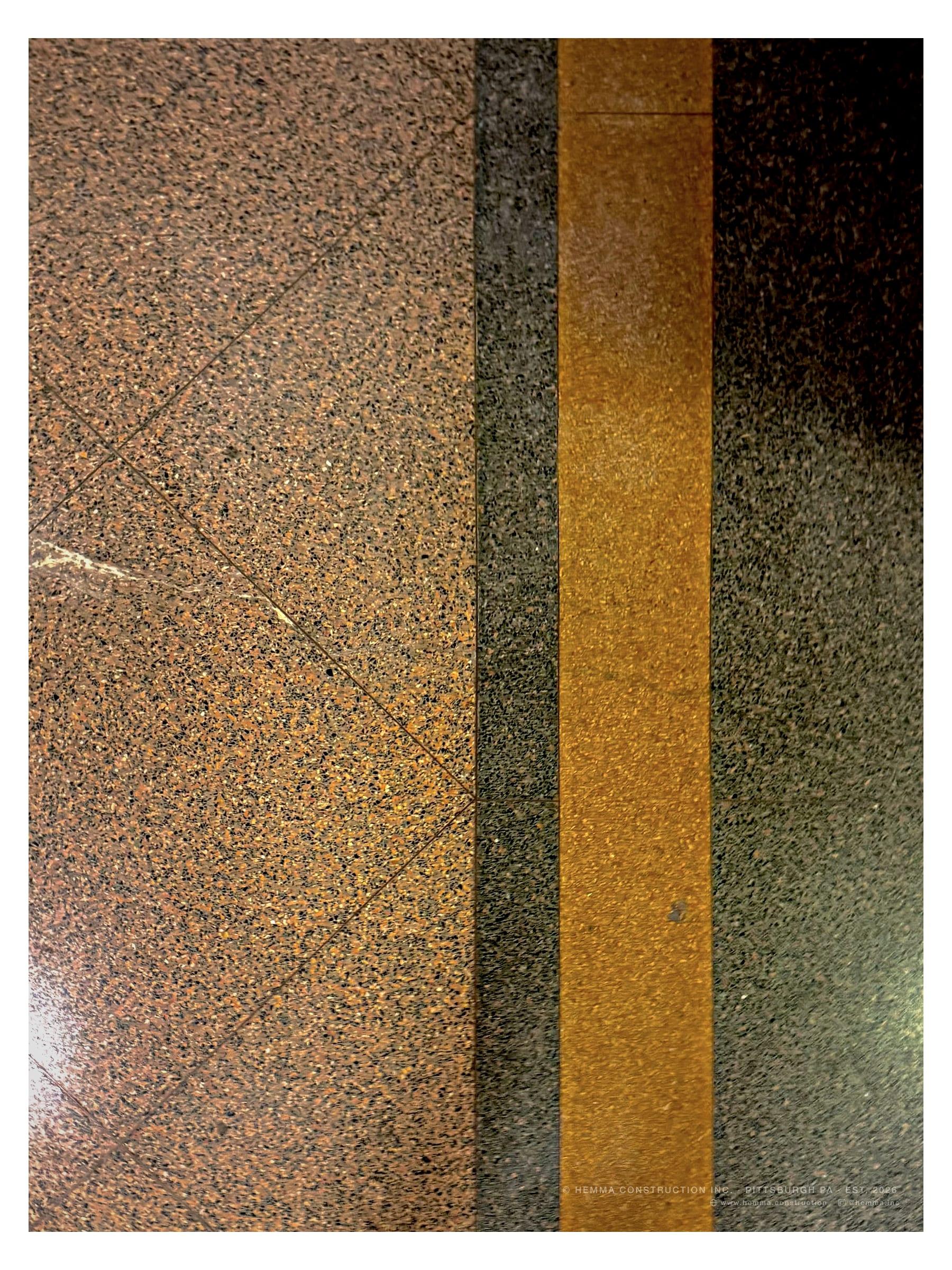
Poured on site. Brass-divided. Polished to six-hundred grit. Sealed.
By Hemma Construction Inc.
PA Licensed & Insured · Entity 15361141 · MMXXVI
II
Pricing
Scoped per project · sample selection at the property walk.
Terrazzo pricing varies by matrix (epoxy or cementitious), aggregate (standard sample range or specialty stone), divider-strip layout, and substrate condition. A poured terrazzo floor in a renovation has a different specification than the same floor in a new pour. The specification document lists every variable by line. There are no allowances.
III
Scope
Included
- Substrate survey — moisture, deflection, crack pattern, bond surface.
- Crack stitching where the substrate asks for it.
- Grind to plane.
- Brass divider strip layout and install.
- Pour — epoxy or cementitious matrix per spec.
- Aggregate selection from sample at the property walk.
- Three-pass grind: coarse, medium, fine.
- Densifier between passes.
- Penetrating impregnator seal.
- Daily site log.
- Final walk before invoice.
Not included
- Permit fees, where required by municipality.
- Subfloor demolition or replacement.
- Heated floor system (separate scope).
- Threshold detail to adjacent flooring.
- Aggregate cost above the standard sample range.
- Wall and ceiling protection beyond standard masking.
IV
Process
I
Inquiry
A quote request form or a call. Response within one business day.
II
Property walk
On-site review within five business days. No fee. We test the substrate, walk the layout, present aggregate samples in person, and discuss matrix and pattern.
III
Specification and proposal
A written specification within ten business days. Matrix, aggregate, divider-strip layout, finish, schedule, line-item pricing. The specification is the contract.
IV
Build
Two to three weeks for a typical residential floor. Substrate prep first, then pour, then a forty-eight-hour cure, then three passes of grind with densifier between. Final seal and walk before invoice.
V
Recent work
VI
Notes from the field
Residential terrazzo is rare in Pittsburgh because the trade is mostly commercial. The equipment, the crew sizes, the production tolerances — all calibrated for airport floors and institutional lobbies, not residential pours. Hemma scales the practice down: smaller crew, residential tolerances, attention to detail at brass divider strips and edge profiles that commercial work does not have time for. The result is a floor that reads as architectural finish rather than industrial floor.
Pittsburgh residential subfloors vary from poured slab on grade to original 1910 wood frame to the engineered subfloor of a 2010 build. Terrazzo bonds to the substrate it is poured on; the substrate has to be evaluated before the pour is bid. We test for moisture content, structural deflection, crack pattern, and bond surface preparation. A pour over a substrate the substrate cannot hold will crack within a year. We will tell you that on the property walk, before any commitment.
Brass strips are the design vocabulary of poured terrazzo. Half-inch standard width, set on edge, soldered at corners, anchored to the substrate with epoxy and small dowels through the slab. The pattern is laid out before the pour and reads through the finished floor exactly as drawn. Concentric rings, a long axis through a room’s hall, a Greek-key border at a threshold — the strip is the line you commit to. We draw layouts to the millimeter on a substrate-scale paper template, lay out test runs in the room before any strip is set, and walk the drawing with the property owner. The pour follows the drawing. The drawing does not change after the pour begins.
Terrazzo’s reputation for being institutional follows from the floors most people remember — airport terminals, post offices, school corridors. Those floors get buffed weekly with industrial machines. Residential terrazzo does not need any of that. The penetrating impregnator seal blocks absorption; a damp mop with a neutral pH cleaner handles routine maintenance; spot polish with a hand pad addresses scuffs. Re-seal every five to seven years if the floor sees heavy traffic; never if it does not. The maintenance burden is lower than engineered hardwood and far lower than sealed concrete. The perception that it is high-maintenance comes from buildings that operate on a commercial schedule, not from the material itself.
VII
Questions
What is terrazzo and how is it different from polished concrete?
Terrazzo is a poured composite — aggregate stone (marble, glass, limestone, mother-of-pearl) suspended in an epoxy or cementitious matrix, then ground and sealed. Polished concrete is the slab itself: ground, densified, and sealed in place. The visual register is different (terrazzo is field-and-aggregate; polished concrete is the substrate showing through), the install is different (terrazzo is poured and finished as its own surface; polished concrete uses what is already there), and the maintenance is different (terrazzo is damp-mop forever; polished concrete needs reseal cycles).
Where can it be installed in a residence?
Floors anywhere — kitchens, baths, mudrooms, foyers, basements, screened porches with proper drainage. Counters and shower walls in the right detail. Stair treads with brass nosing where the geometry asks. Site-poured terrazzo bonds to a clean, level, structurally-sound substrate; we evaluate the slab before bidding.
How long does it take?
Substrate prep: two to four days. Divider-strip layout and pour: one to two days. Initial cure: forty-eight hours. Three-pass grind with densifier between passes: three to five days. Penetrating impregnator seal and cure: two days. Total: two to three weeks for a typical residential floor, weather and humidity permitting.
How do you maintain it?
Damp mop with a neutral pH cleaner. That is the maintenance. There is no wax to strip, no sealer to refresh on a schedule, no pH-sensitive grout to baby. A penetrating impregnator does the protection, and the sealed surface does not absorb spills the way grout does. Spot-polish a scuff if one appears; otherwise, mop.
What aggregates are available?
Standard sample range covers white and grey marble, limestone, common glass, and a small palette of mother-of-pearl. Specialty aggregates (rare stone, custom-color glass, brass and aluminum chips, oyster shell) are sourced to the design — priced at install. The aggregate is selected from a physical sample at the property walk, not from a screen.
Can it match a specific color or pattern?
Yes — within the bounds of the matrix and aggregate available. We pour test panels for any color critical to the design before committing to the install. Brass divider strips lay out the pattern on the substrate before the pour. The pattern in the finished floor matches the strip layout exactly; the color matches the test panel.
Why is residential terrazzo so rare in Pittsburgh?
Two reasons. First, the trade is mostly commercial — institutional floors in airports, civic buildings, schools — and the equipment scales for those. Residential pours need a smaller crew willing to work to residential tolerances. Second, the perceived install cost. Terrazzo lifetime cost is favorable against engineered hardwood or stone tile; the install is what filters operators out. Hemma pours residential because the substrate is interesting and the finish lasts forever.
What does it cost compared to other floor finishes?
At install, terrazzo runs higher than tile or engineered hardwood. Over twenty years, terrazzo runs lower than either — no refinish cycles, no replacement of broken tile, no joint failure. The number depends on aggregate and area; the property walk produces a real specification.
VIII
Service area
Counties
Allegheny County
Westmoreland County
Armstrong County
Indiana County
Neighborhoods
Squirrel Hill
Shadyside
Highland Park
Fox Chapel
Aspinwall
O’Hara Township
Mt. Lebanon
Upper St. Clair
Sewickley
Edgewood
Regent Square
Point Breeze
Zip codes
15201
15202
15203
15205
15206
15208
15209
15211
15213
15215
15216
15217
15218
15219
15220
15221
15222
15224
15226
15228
15232
15234
15238
15241
15243
IX · Request quote
Five fields. We respond within one business day. The property walk is scheduled within five.
Or call the studio at (412) 900-9228