Hemma · Driveway · MMXXVI
Tile baths · Pittsburgh and Western Pennsylvania
Substrate first. Waterproofed to a system. Tile to a published spec.
By Hemma Construction Inc.
PA Licensed & Insured · Entity 15361141 · MMXXVI
II
Pricing
Scoped per project · property walk required · fifty-percent deposit at signing.
A half-bath refresh and a full-bath gut to the studs sit at opposite ends of the bill. The specification document delivered before any agreement is signed lists every variable by line — substrate, waterproofing system, tile selection, plumbing rough, electrical rough, finish hardware. There are no allowances. Pricing is firm at signature.
III
Scope
Included
- Demo of existing tile, fixtures, and substrate.
- New substrate prep — backer board or uncoupling membrane per spec.
- Waterproofing per spec — sheet membrane, liquid-applied, or hybrid.
- Tile setting in mortar over uncoupling membrane.
- One-eighth inch grout joint as residential standard; sealed.
- Plumbing rough and trim — supplies, drains, fixtures.
- Light electrical — GFCI, fan, light, switching.
- Daily site log.
- Final walk before invoice.
Not included
- Permit fees, where required by municipality.
- Tile and fixture material costs (sourced separately on a published spec).
- Structural framing changes beyond minor blocking.
- HVAC modifications.
- Drywall finishing beyond the wet zone.
- Painting beyond touch-up at tile edges.
- Cabinetry beyond vanity install.
IV
Process
I
Inquiry
A quote request form or a call. Response within one business day.
II
Property walk
On-site review within five business days. No fee. We measure, evaluate the substrate, identify the waterproofing system the property asks for, and walk the tile selection with the owner.
III
Specification and proposal
A written specification within ten business days. Substrate, waterproofing system, tile package, fixture schedule, line-item pricing. The specification is the contract.
IV
Build
Two to three weeks for a half-bath refresh. Five to eight weeks for a full-bath gut, depending on the tile package. Daily site log. Final walk before invoice.
V
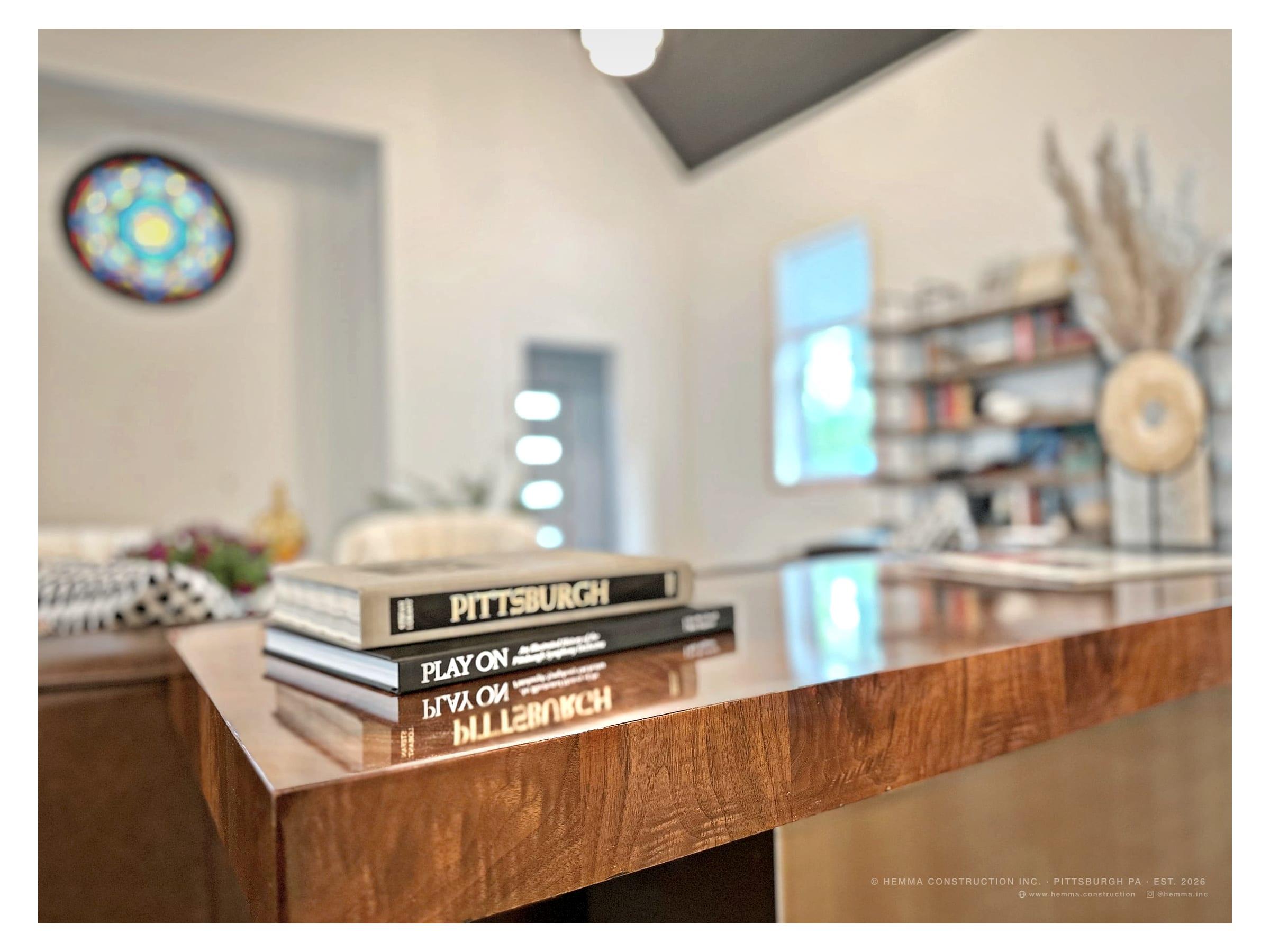
Recent work

VI
Notes from the field
Pittsburgh housing stock is full of crooked walls — 1910 frame on lath, plaster bowed by a century of seasonal humidity, subfloors that creak under load. A bath retrofit on a wall this old starts with measurement and ends with a substrate that meets modern tolerance. We sister joists where deflection exceeds spec, lay uncoupling membrane on subfloors that have lived through three boilers, and frame the wet zone to plumb and level — even when the rest of the room is not. The visible part of a Hemma bath is the tile. The part that lasts is the substrate.
Waterproofing is where most renovations fail in Western Pennsylvania. The freeze-thaw cycle pushes moisture into and out of the wall behind a poorly-flashed shower head, and within five years the substrate has rotted out behind tile that still looks fine on the surface. A Hemma bath uses a named waterproofing system — sheet membrane, liquid-applied, or hybrid — and the system is on the specification, not in the contractor’s head. The system has a manufacturer warranty; we honor it. Cheaper substitutions are not made without the property owner present.
Tile selection runs ahead of the install. Porcelain to the field for moisture stability, ceramic for budget zones where dimensional tolerance is generous, natural stone for the moments that ask for it — but every selection comes with a setting bed and a grout that suits its absorption rate. Modified thinset where the substrate flexes; unmodified mortar where the manufacturer requires it. Cement-based grout sealed within forty-eight hours of cure; epoxy grout where staining matters more than cost. The mortar and the grout are on the specification with the tile; substitutions require a written change order because the chemistry, not the trade, is what fails first.
Western Pennsylvania bath retrofits land disproportionately in pre-1940 housing — lath plaster walls, knob-and-tube wiring still in service to a corner, cast-iron drain stacks running through floor cavities. We rebuild what does not meet code. Cast iron stays where it sounds intact; we replace where it does not. Knob-and-tube comes out of any wall we open. Lath plaster gets boxed back to studs in the wet zone, replaced with cementitious backer board, waterproofed to spec — but stays in the dry zone where the original keeps the room’s voice. The bath that lasts a century is the one that does not pretend the rest of the house is new.
VII
Questions
What's a typical timeline for a half-bath versus full bath?
A half-bath refresh — new tile, new vanity, new fixtures over an intact substrate — runs two to three weeks. A full-bath gut to the studs with new substrate, waterproofing, plumbing rough, and finish trim runs five to eight weeks depending on the tile package. The schedule is named in the specification before the work begins.
What tile do you work with — anything we choose?
Anything we choose, with one constraint: tile sets to a published specification, so substitutions require a written change order. Stone, porcelain, ceramic, glass, terrazzo tile, encaustic — all in the practice. Hand-cut and miter-cut profiles where the design asks for them. We read the spec sheet before bidding so the install accommodates the material’s tolerance.
How do you waterproof?
Waterproofing is the part you do not see and the part the bath stands or fails on. We use sheet membrane (Schlüter Kerdi), liquid-applied (Laticrete Hydroban), or a hybrid system depending on the substrate and the design — pre-formed shower pan curbs and corners where the geometry asks for them, custom-flashed where it does not. The waterproofing system is named on the specification.
What does the demo include?
Demo includes everything between the existing finish and the framing — tile, substrate, fixtures, fittings, drains. Anything wet, brittle, or compromised comes out. We bag and haul off the same day. Demo of structural framing is a separate scope.
Will the bathroom be unusable during the work?
Yes — for the duration of the build. A single bath in a single-bath house means you arrange a temporary off-site solution or schedule the work around a stay elsewhere. If the property has a second bath, that one stays operational. We do not phase a single bath build to keep it half-usable; the result is two unfinished baths instead of one finished one.
Do you handle plumbing and electrical?
Yes — supply rough, drain rough, fixture trim, and the GFCI / fan / light electrical that a bath needs. Major service changes (panel upgrade, sub-panel install) are a separate scope. We pull permits where the municipality requires them; permit fees pass through at cost.
What about historic homes — anything different?
Older homes have crooked walls, marginal subfloors, and lath-and-plaster substrates that do not bond to modern thinset. We sister, level, and rebuild substrates as the property asks for them. We use uncoupling membrane (Schlüter Ditra) over questionable subfloors. We do not skim over a problem; we fix the problem. The spec names the deviations from a stock install.
How are you priced?
At the upper end of the local range. The premium is the substrate and the waterproofing, which other contractors compress to keep a price competitive. The result is a bath that performs for the full life of the tile. Lifetime cost is the right comparison.
VIII
Service area
Counties
Allegheny County
Westmoreland County
Armstrong County
Indiana County
Neighborhoods
Squirrel Hill
Shadyside
Highland Park
Fox Chapel
Aspinwall
O’Hara Township
Mt. Lebanon
Upper St. Clair
Sewickley
Edgewood
Regent Square
Point Breeze
Zip codes
15201
15202
15203
15205
15206
15208
15209
15211
15213
15215
15216
15217
15218
15219
15220
15221
15222
15224
15226
15228
15232
15234
15238
15241
15243
IX · Request quote
Five fields. We respond within one business day. The property walk is scheduled within five.
Or call the studio at (412) 900-9228